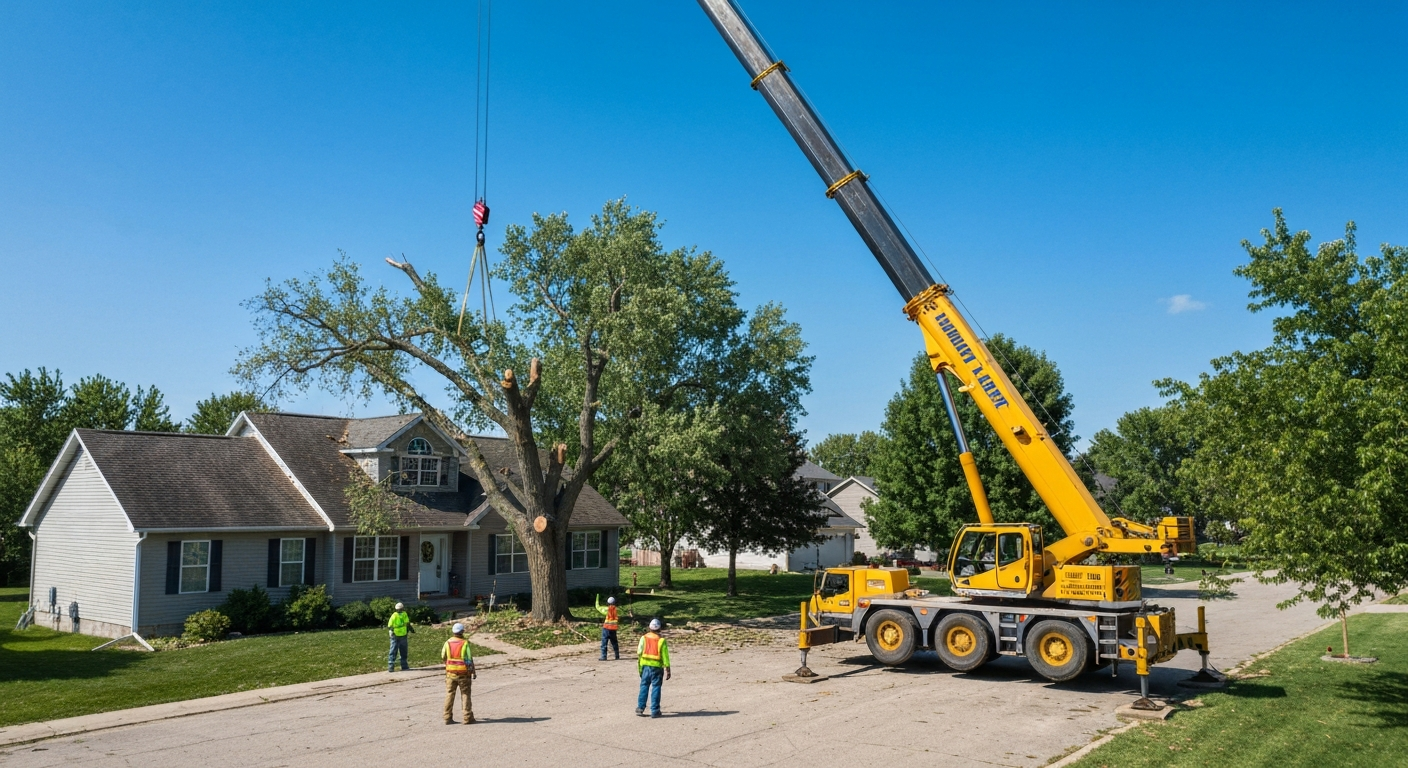
Lot & Land Clearing for Residential and Commercial Sites.
From single-lot new construction prep to multi-acre rural clearing. We remove trees, grind stumps, chip brush, and leave the site grade-ready — all in one engagement.
- Residential & commercial clearing
- Selective or full-lot clearing
- Stump grinding to grade
- Brush chipping & hauling
- Agricultural & rural sites
- Development-site coordination
Land clearing is one of the most equipment-intensive services in arboriculture. It requires not just chainsaws and chippers, but the coordination to move efficiently across a site, protect any trees being retained, and deliver a cleared area that a construction crew or landscaper can work with immediately. Our partners have both the equipment and the project management experience to handle clearing jobs from a single backyard lot to multi-acre rural properties.
Residential Lot Clearing
Preparing a residential lot for new construction, a pool, a garage, or a major landscaping renovation all require clearing trees and brush from specific areas — sometimes selectively (removing only certain trees while protecting others) and sometimes fully (clearing the entire lot for a clean slate). We provide selective clearing with tree protection zones for specimens the owner wants to keep, or complete clearing for blank-slate projects. Full debris removal, stump grinding to grade, and cleanup are included.
Rural & Agricultural Clearing
Fence line clearing, woodlot edge management, shelter belt thinning, and clearing for agricultural building sites are common projects across Muscatine County's rural properties. We're accustomed to working in agricultural settings — managing access for large equipment, avoiding tile lines and field drainage infrastructure, and handling the species mix typical of Iowa river-corridor woodlands (cottonwood, silver maple, box elder, willow, elm, and ash).
Commercial & Development Site Clearing
Development projects in Muscatine County increasingly require tree impact assessments and mitigation plans as part of the permitting process. We can coordinate with your civil engineer or landscape architect to identify trees to be retained, provide protection specifications, and execute clearing in phases to align with construction staging. All work is documented for permit compliance.
Material Disposition
Cleared material can be handled several ways depending on your project: brush chipped on-site (chips left as ground cover or hauled), logs bucked to firewood lengths for retention or sale, stumps ground to grade or removed by excavation for below-grade construction, and all debris hauled off-site for a clean delivery to your contractor or landscaper. We'll confirm disposition preferences during the estimate.
Frequently Asked Questions
Do I need permits for land clearing in Muscatine?
It depends on the project scope, location, and zoning. Muscatine County and municipal jurisdictions have different requirements for land clearing in advance of construction. We can advise based on your specific project and location, and we're experienced with the documentation requirements for permitted clearing projects.
Can you clear a lot that has been abandoned and overgrown for years?
Yes. Heavily overgrown lots with multi-stem thickets, invasive species (honeysuckle, buckthorn, multiflora rose are common in Iowa), and self-seeded volunteer trees are a standard clearing challenge. We assess the species mix and plan the approach accordingly — mechanical chipping for brush, removal for trees above a certain DBH, and stump grinding throughout.
Can you protect specific trees while clearing the rest of the lot?
Absolutely. Selective clearing is the majority of what we do on residential projects. We establish tree protection zones (TPZ) around trees to be retained and communicate clearly with the crew about what stays and what goes. On construction projects, we can install temporary fencing around TPZs to protect root systems from equipment compaction during the construction phase.