Emerald Ash Borer, Oak Wilt & Dutch Elm Disease.
Iowa's trees face three major disease and pest threats. We identify, advise, and safely remove compromised trees before disease spreads to your healthy canopy.
- EAB ash identification & removal
- Oak wilt timing protocols
- Dutch elm management
- Hazardous ash crane removal
- Disease spread prevention
- Free written estimates
Iowa has lost tens of millions of ash trees to the Emerald Ash Borer since it was first detected in the state in 2003. Oak wilt continues to advance northward and westward across the state. Dutch elm disease — though well-established — still kills elms throughout Muscatine County every season. Our network brings both the diagnostic knowledge to identify them correctly and the equipment to remove compromised trees safely.
Emerald Ash Borer (EAB) — Iowa's Largest Tree Killer
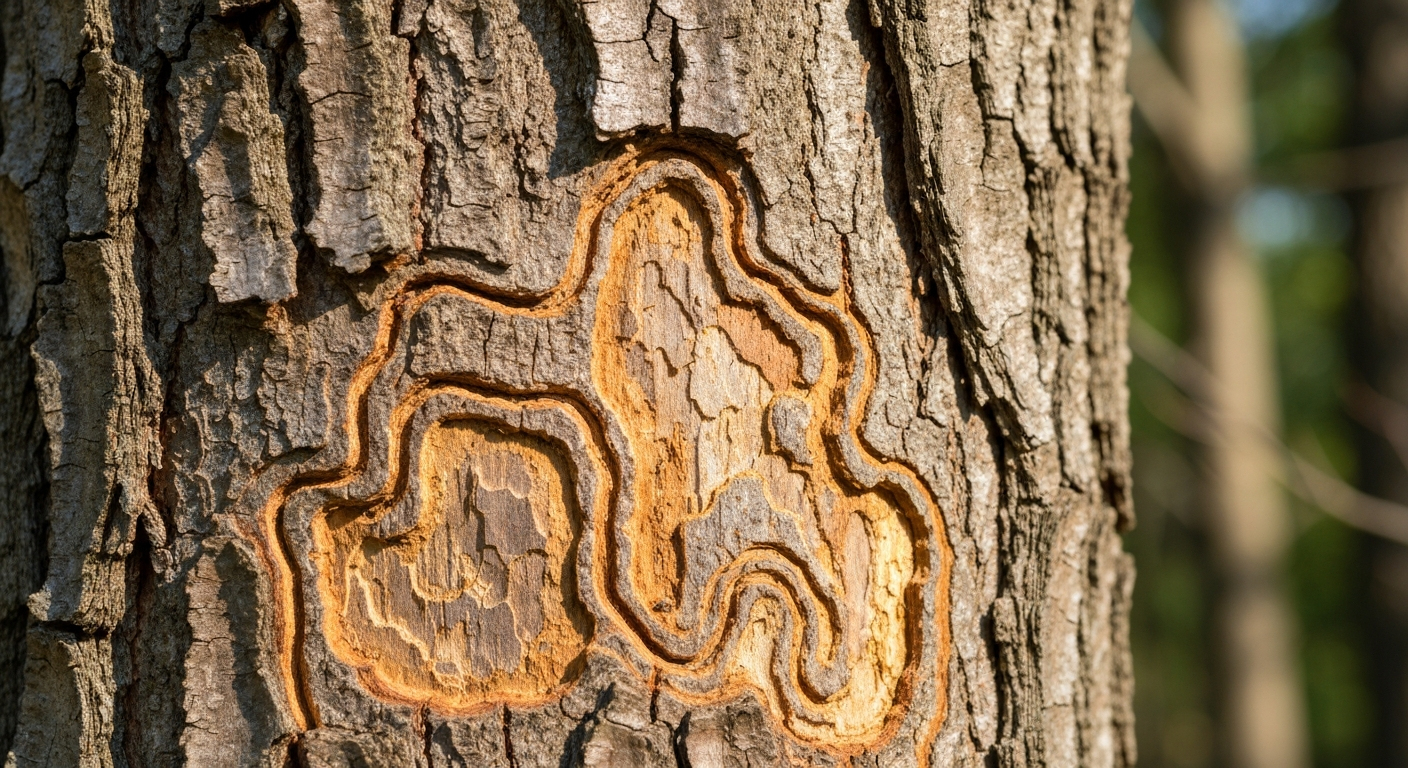
EAB (Agrilus planipennis) is an invasive beetle from Asia that has killed billions of ash trees across North America. It attacks all species of true ash (Fraxinus) — green ash, white ash, black ash, blue ash. The signs: canopy dieback beginning at the crown top, 'blonding' of the outer bark where woodpeckers have stripped it searching for larvae, S-shaped serpentine galleries visible beneath loose bark, and D-shaped adult exit holes approximately 1/8 inch wide. By the time symptoms are obvious, the tree is typically 50–70% compromised. Removal decisions should be made promptly — a heavily EAB-infested ash becomes dangerously brittle and unpredictable, particularly in the crown.
Oak Wilt — Time-Critical Pruning Windows
Oak wilt (Bretziella fagacearum) is a fungal disease that kills oaks by blocking xylem water transport. Red oaks are most susceptible — they can die within weeks of infection. White oaks are more resistant but can be killed over multiple seasons. The critical management point: oak wilt spreads through fresh pruning wounds during the sap beetle season (approximately April through July in Iowa). Oaks should only be pruned in late fall and winter. If you must prune in summer (storm damage, for example), wound paint should be applied immediately. We enforce strict timing protocols on all oak pruning work.
Dutch Elm Disease — Still Active in Muscatine County
Dutch elm disease (Ophiostoma ulmi) has been killing American elms since the 1930s. It spreads through elm bark beetle activity and through root grafts between adjacent elms. Symptoms include yellowing and wilting of individual branches ('flagging'), progressing to full crown wilt. Salvage treatments exist for mildly infected elms; significantly infected trees require removal and disposal of infected wood to prevent beetle-mediated spread.
Safe Removal of Disease-Compromised Trees
EAB-infested ash trees in late stages of infestation are among the most hazardous removals in arboriculture. The crown becomes brittle and unpredictable — dead branches can shear off unexpectedly during climbing or cutting. We approach advanced EAB ash removals with the same precautions we apply to all hazardous removals: full site assessment, crane-assisted extraction where proximity to structures is present, and fully suited-up climbers where climbing is necessary.
Frequently Asked Questions
My ash tree is losing leaves at the top — is it EAB?
Upper crown dieback in ash is a classic early EAB symptom, but it's not definitive on its own. Upper crown dieback can also be caused by drought stress, root damage, or other borers. A proper diagnosis involves checking for S-shaped galleries under the bark, D-shaped exit holes, and blonding from woodpecker activity. Call us for a free assessment — we'll tell you what you're dealing with and what the options are.
Can I save my ash tree from EAB?
Possibly, if caught early enough. Insecticide treatments (emamectin benzoate trunk injection, imidacloprid soil drench) can be effective for trees with less than 30% canopy dieback. Once decline exceeds 50%, treatment success rates drop significantly and removal may be the more prudent choice. We can advise on the realistic prognosis for your specific tree.
Can I prune my oak in the spring?
We strongly advise against it. The sap beetle activity window in Iowa (roughly April through July) is when fresh oak pruning wounds are at highest risk for oak wilt infection. We schedule all oak pruning work in late fall and winter. If a spring emergency requires pruning, we apply wound paint immediately after every cut.