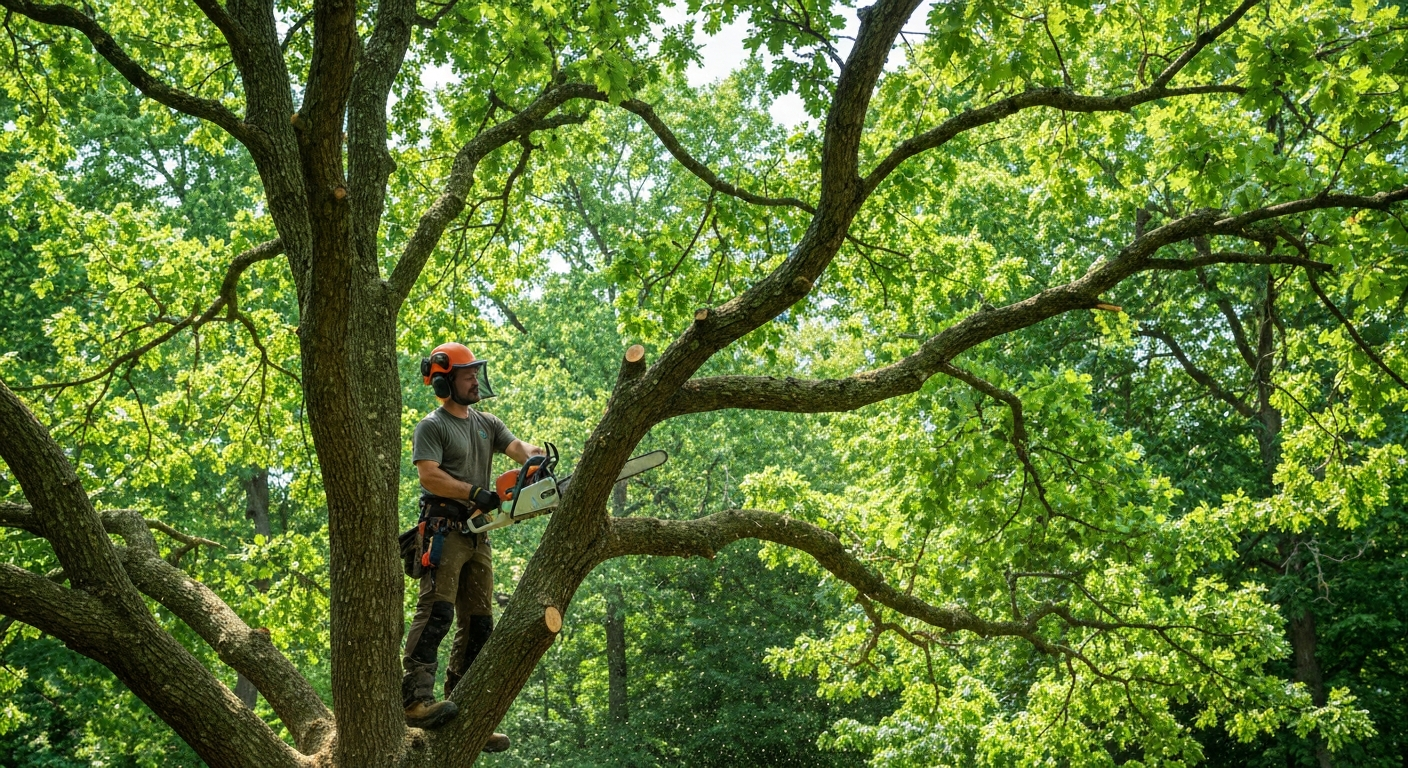
Structural Support to Extend Your Tree's Life.
When a heritage tree shows structural weakness, the right response isn't always removal. Cabling and bracing can safely preserve your most valuable trees for decades to come.
- ISA-standard cable installation
- Steel EHS & synthetic options
- Bracing rods for splits
- Heritage tree preservation
- Annual inspection programs
- Residential & commercial
A 200-year-old bur oak with a co-dominant stem isn't a liability — it's a legacy. The right structural support system, properly installed and maintained, can extend that tree's functional life for another generation. Our partners design and install cabling systems to ISA standards for residential, commercial, and municipal clients across Muscatine County.
When Is Cabling or Bracing Indicated?
The most common scenarios: a co-dominant stem (two trunks emerging at a narrow V-angle, sharing a weak included bark junction), a heavy horizontal limb extending over a structure or high-traffic area, an asymmetric crown producing excessive wind-load on one side, or a tree that has previously lost a major limb and is overcompensating with heavy regrowth on the opposing side. A properly placed cable system redistributes the load so no single union or limb carries more than it can handle.
Steel Cables vs. Synthetic (EHS) Systems
Traditional high-strength steel strand cable (EHS — Extra High Strength) has been the industry standard for decades. It's rigid, highly durable, and appropriate for most residential cabling applications. Synthetic systems (Cobra, TreeSave, Arbortie) use dynamic webbing materials that allow more movement and are installed as 'supplemental' support rather than rigid restraint — they're preferred for trees where some dynamic movement is desirable to promote trunk taper and trunk strength. We'll recommend the appropriate system based on your tree's species, structure, and the loads involved.
Bracing Rods for Included Bark Splits
Where a co-dominant stem has already begun to split at the union — with included bark visible as an inward-growing seam — a threaded steel bracing rod installed through both stems mechanically binds them together. Rods are used in conjunction with cables, not as a substitute. This is one of the more technically demanding aspects of tree support work — placement angle and depth matter significantly for effectiveness.
Annual Inspection Program
Cable and rod systems require periodic inspection — typically annually — to assess cable tension, hardware corrosion, attachment point integrity, and changes in the tree's structure since installation. We offer annual inspection programs for clients with installed systems so you're not left guessing whether your support system is still doing its job.
Frequently Asked Questions
Does cabling make a tree completely safe?
No. Cabling reduces risk — it does not eliminate it. A cable system supplements the tree's structure; it cannot replace sound wood. Trees with extensive internal decay, severe root damage, or late-stage disease may not be appropriate candidates for cabling. We'll give you an honest assessment during the free evaluation.
How long do cable systems last?
Quality EHS steel cable installations typically last 10–15 years before hardware inspection and potential replacement is warranted. Synthetic systems may have different inspection cycles. The tree grows around anchor hardware, and the system's effectiveness changes as the tree matures — annual inspection keeps you informed.
Can you cable a tree that's already been topped or badly pruned?
Sometimes, but the challenge is greater. Topped trees produce weakly attached epicormic sprouts that are prone to failure regardless of cable support. We'll assess what's possible and give you an honest picture of what cabling can realistically accomplish given the tree's current condition.